Climbing Adam’s Peak in Sri Lanka: A Complete Guide
Some links on this page may be affiliate links. That means if you follow one, see something you like, and purchase it, I may receive a small commission at no cost to you. For more information, see this site's disclosures.
Climbing Adam’s Peak was one of the most memorable and unique experiences I had in Sri Lanka. In this guide, I’ll outline how to get there, what to expect, and why you should get going at an ungodly hour in the morning.
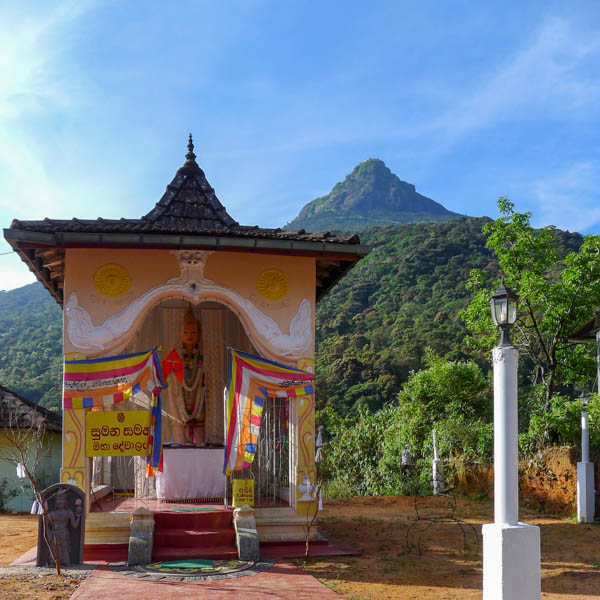
From a distance, Adam’s Peak appears to be a perfectly formed mountain – like the Matterhorn, maybe, or the Paramount Pictures logo. At 7,359 feet (2,243 meters), it’s not tall enough for that dramatic, snow-capped effect – but it’s still an almost picture-perfect peak. You can see, without knowing anything else about it, why people would be drawn to it.
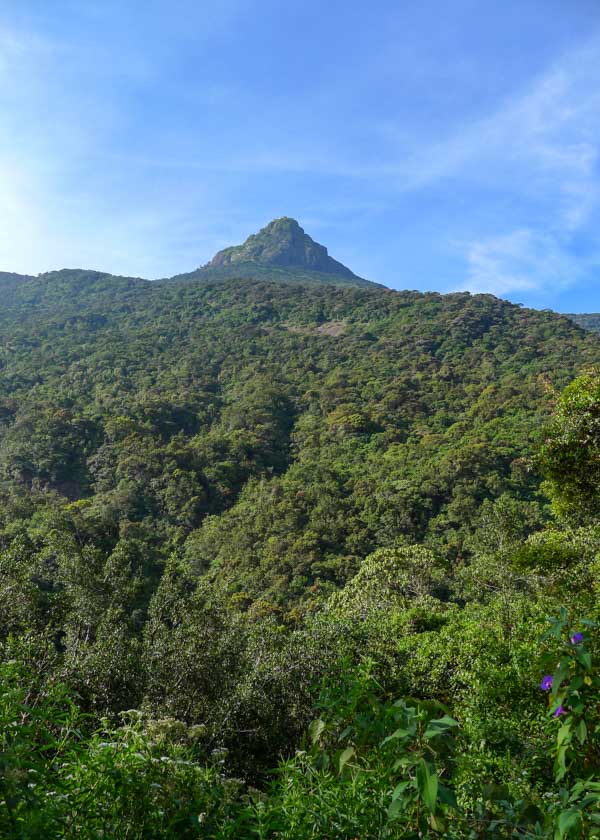

Thanks to a rock formation at the top resembling a large footprint, the peak is one of the most important places of pilgrimage in Sri Lanka. According to Buddhists, this sacred footprint belonged to none other than Buddha himself. Hindus believe it was made by the god Shiva. Muslims and some Christians say the footprint is that of Adam, while other Christians believe it was made by St. Thomas.
People of all four faiths (as well as a healthy number of tourists) climb Adam’s Peak every day during the pilgrimage season from December to May. You can do this at any time of year, but experiences will vary widely between the low and high seasons.
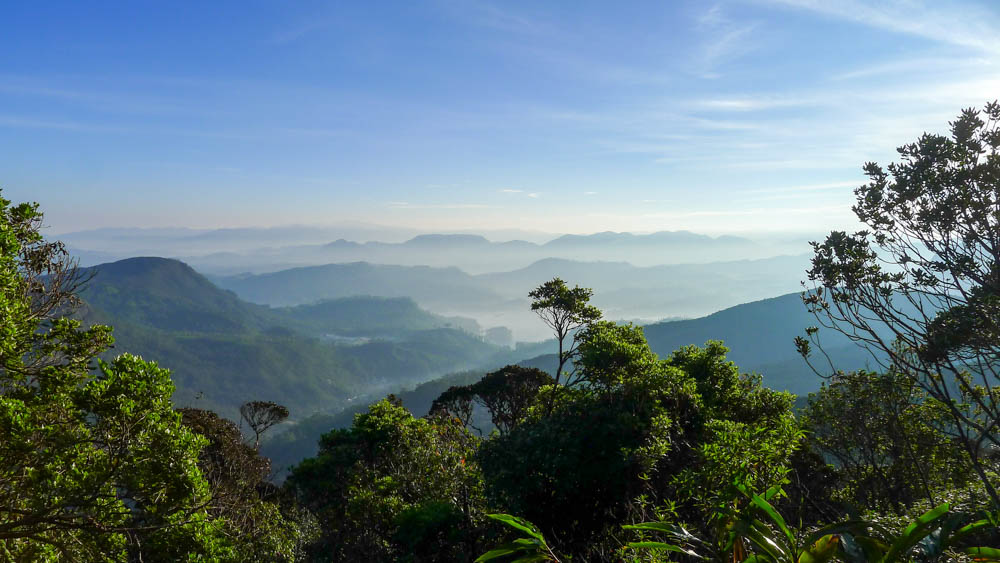
Even if the weather doesn’t cooperate, the experience of climbing Adam’s Peak with hundreds of pilgrims is truly unforgettable. I found the whole morning really special and moving.
As the climb is pretty tough, there is a sense of camaraderie among pilgrims and tourists alike. Stopping to enjoy a fresh roti and tea with a handful of strangers at 4:00 in the morning, you can easily convince yourself that this is all good fun!
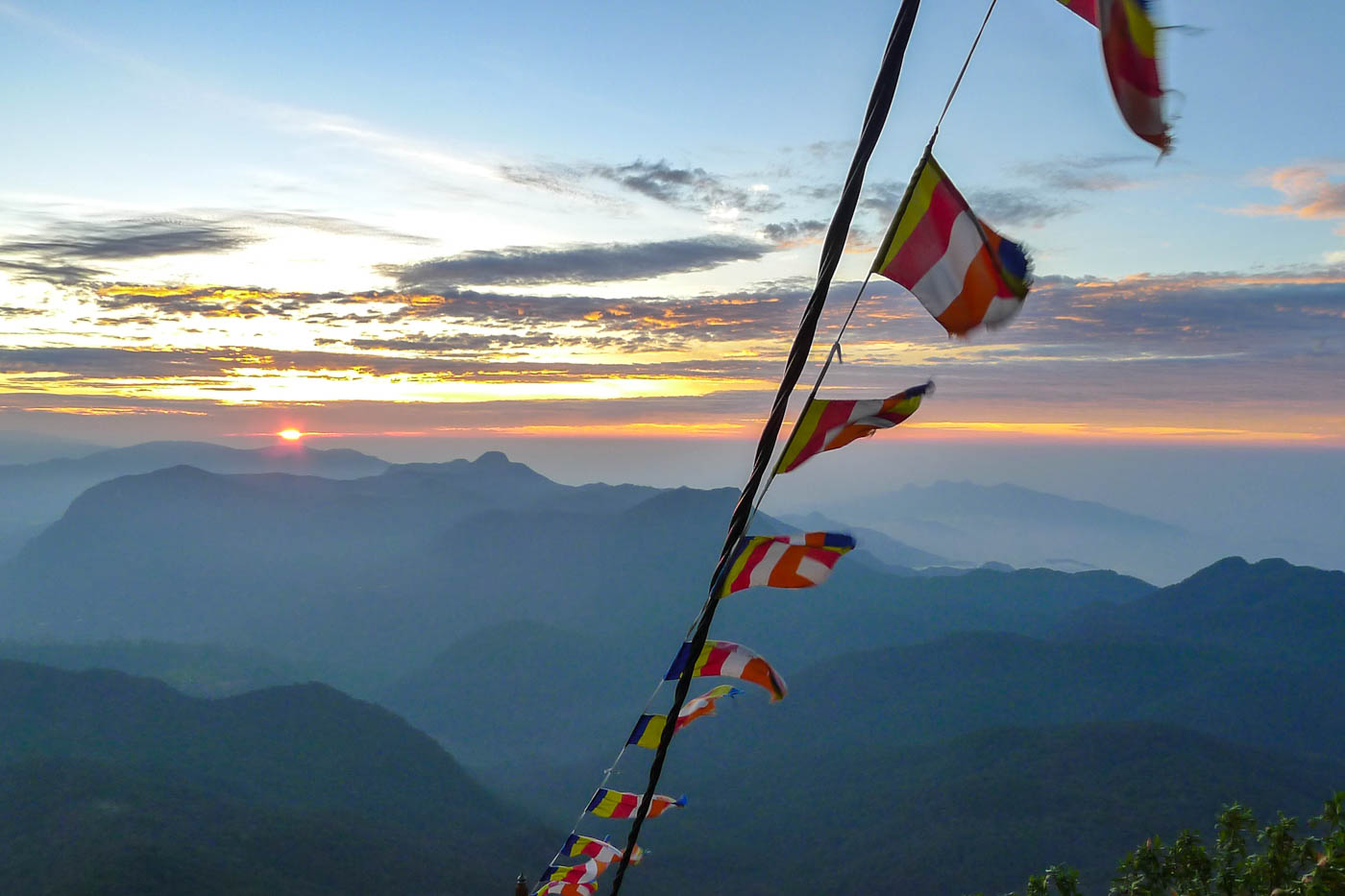
At the summit, you really appreciate the spiritual significance of this journey for so many people. Drums and chanting play over a loudspeaker as the sun begins to rise. It is nothing short of breathtaking.
If you’re going as a tourist rather than a “pilgrim” per se, keep in the front of your mind that this is a religious experience for most of the other people around you. It’s always important to be respectful, even more so in a place that is considered so sacred. (I will never forget the tourists in front of me on the way down, blasting EDM music from a portable speaker. So utterly embarrassing.)

There is a small temple at the summit where you can walk past the sacred footprint. There is also a bell to ring (once for each time you’ve summited the mountain, according to tradition).
On a clear day, the mountain casts an otherworldly shadow in the shape of a perfect triangle above the surrounding peaks.
When is the best time to climb Adam’s Peak?
As mentioned above, the pilgrimage season generally runs from December to May, with January and February being the busiest months. If you happen to be there on a weekend or public holiday, expect even larger crowds.
The rest of the year, it is much rainier and therefore much quieter. The temple at the peak is closed, and the path is unlit. (I did mention you’ll be hiking in the middle of the night, right?) There are very few, if any, vendors selling food and drinks along the route during the rainy season.
The weather, of course, is not entirely predictable. You could have a rainy day with no visibility during the dry season, just as you could have an unexpectedly clear view during the low season.

Still, climbing Adam’s Peak is about much more than the view. Personally, I think a high-season day with no view might still be more memorable than a low-season day with nice weather.
As just a hike, a purely physical endeavor or a way to enjoy the outdoors, climbing Adam’s Peak isn’t that exceptional. The path is entirely paved – it’s basically a never-ending concrete staircase. You’re probably not going to feel like you’re one with nature or anything like that. (If that’s what you’re seeking, some of the other hikes in Sri Lanka may suit you better.)
The shared experience and the window into different cultures are what make this long hike in the dark worth it. I would probably still hike it in the low season, but I’d manage my expectations.

Of course, if this is a religious experience for you, you might prefer to climb Adam’s Peak in the solitude of the low season. And you may not really care about the weather.
How long does it take to climb Adam’s Peak?
The 7-kilometer path to the summit includes roughly 5,500 stairs. Early in the hike, you’ll alternate walking on flat surfaces and ascending the steps. You won’t be able to tell in the middle of the night, but the route takes you through tea plantations and lush green forest. (On the way back you can admire the scenery and hopefully spot some birds and monkeys.)
Enjoy this part. As you can imagine from looking at a picture of the peak, those welcome, flat breaks become more infrequent the higher you get.


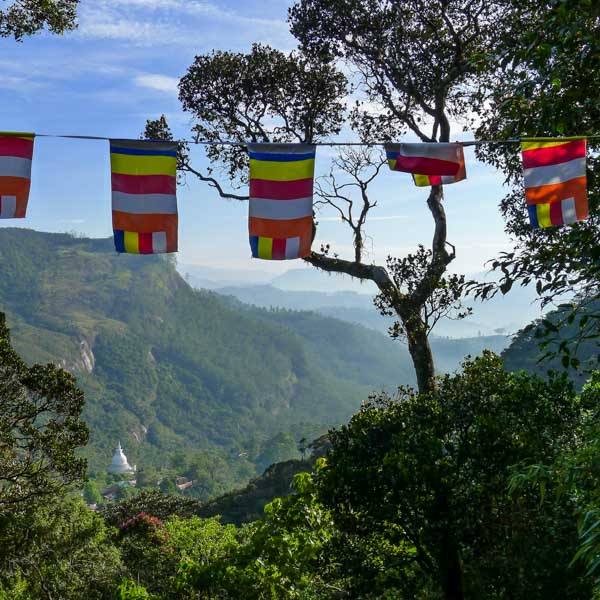
You’ll pass under a large arch demarcating the official start of the sacred area. Take note of the white Japanese Peace Pagoda, which is visible from many places further up the path. It’s a fun and somewhat motivating exercise to watch it grow smaller and smaller as you work your way up the mountain.
There are many small teashops along the route where you can enjoy a warm meal and a hot drink. (I will take this opportunity to warn you that the bathroom situation is pretty dismal. You’ll obviously need to drink plenty of water, but I’d save my coffee for the way down.)
If you’re in good physical shape and don’t take too many long breaks on the way up, it takes about three hours to reach the summit.

The way down is usually faster, as long as you don’t have knee trouble. Count on 1.5 to 2 hours. Keep in mind, though, that this is when you’ll finally get to appreciate the incredible scenery you missed in the dark!
Note that no matter what kind of shape you’re in, climbing Adam’s Peak is rough on the quads and knees. Full stop. Prepare to hobble around for the next few days.
What time should you start climbing?
Before setting your alarm, you’ll want to consider how far you are from the start of the trail, what time the sun rises, and how quickly you think you can climb those 5,500 steps. The sun usually rises between 6:00 and 6:30, but double check the exact time for the date you plan to visit. Sri Lanka is pretty close to the equator, so you won’t see a huge difference in sunrise times at different times of the year.

If your guesthouse is in Nallathanniya/Dalhousie, you can head straight to the trail on foot. From Hatton, Maskeliya, or one of the guesthouses on the shores of the reservoir, you’ll need to arrange a tuk-tuk. (Your accommodation provider should be able to help with this.)
I left my guesthouse on the reservoir at about 2:45, sharing a tuk-tuk with a new friend I’d met at dinner. We started hiking a little after 3:00.
Our host pushed us to leave earlier, but I couldn’t stomach the thought and know I am a fast hiker when I need to be. It’s pitch black on the way up, so it’s not like you’ll need time to stop and admire the scenery!

Timing your arrival at the summit is a bit of a balancing act. If you’re there on a busy day, it can be difficult to find anywhere to sit and watch the sun come up. It’s really cold and windy up there, though, so you don’t want to arrive too early either.
I got to the top around 30 minutes before sunrise, which was a pretty good compromise. I didn’t have the best view in the house, but I was still able to move my fingers when the time came to take pictures!
How to get to Adam’s Peak via Hatton, Maskeliya, and Dalhousie
If you’re traveling along the ever-popular Kandy-Ella train line, you’ll need to stop in Hatton to climb Adam’s Peak.

Hatton is about 2.5 hours from Kandy, a little over an hour from Nanu Oya, and about 4 hours from Ella. (These times are based on express train schedules; the mixed trains are slower.)
At certain times of day in the high season, there is a direct bus from Hatton all the way to Nallathanniya, also known as Dalhousie, at the base of Adam’s Peak.
Hatton bus stand is about five minutes south of the train station on foot. The bus to Nallathanniya takes about 2 hours, including stops.
If there is no bus to Nallathanniya, take a bus to Maskeliya instead. From there, you can change to a smaller bus that runs around the reservoir to Nallathanniya. It makes frequent stops, so you can hop off if your guesthouse is somewhere along the lake.

If this sounds like too much messing around and you have room in your budget, you can always take a tuk-tuk from Hatton straight to your guesthouse.
Where to stay before climbing Adam’s Peak
You can stay in Hatton, but you’ll have a much longer (about an hour and a half) and more expensive drive to the start of the hike on an already very early morning.
I recommend staying in Nallathanniya (Dalhousie) if you can. From here, you can walk straight from your room to the trail.
If nothing is available within your budget in Nallathaniya, try to book one of the guesthouses peppered around the Maskeliya reservoir instead. You’ll probably still need a tuk-tuk in the morning, depending on where exactly you sleep, but you will be much closer to the bridge that marks the start of the climb.

I found a great budget guesthouse nestled among rows of tea on the shores of the lake. It was about 15 minutes from the start of the hike by tuk-tuk.
What should you bring on your hike?
Even if the days are warm and pleasant down in Nallathanniya, the nights are cold. And the nights on top of an exposed mountain peak before sunrise? Downright freezing.
Wear warm clothing and sturdy footwear
Make sure you bring a few layers, a hat, and some gloves. If you didn’t pack winter clothes to come to a tropical island in the Indian Ocean, worry not. There are vendors in Nallathanniya, and at small shops around the lake, selling warm clothing for a few hundred rupees.
You will see people climbing Adam’s Peak in flip flops, and some will even be barefoot. Unless you have a religious or spiritual reason for doing so, however, I would suggest sturdier footwear. You don’t need hiking boots, but running shoes/trainers are recommended. Leeches come out in rainy weather, so I would opt for closed-toe shoes with socks rather than hiking sandals. Long pants are also recommended for this reason.

Food, water, and other items
Of course, you should also bring water. If you’re climbing Adam’s Peak in the off season, I would bring at least couple of liters with you. During pilgrimage season, you can always buy more at the shops along the route.
Similarly, you’ll want to pack some breakfast and snacks if it’s low season. In high season, you can eat at a teashop for a little break during your ascent, or as a well-earned reward on the way down. You may still want to pack a small snack for the summit. There aren’t any vendors once you get to the steepest part of the trail near the top, and you might want to sit up there for a while.
I also recommend bringing toilet paper and hand sanitizer/wipes. The bathroom situation is not great.
In the low season, the path isn’t lit, so you’ll want a headlamp if you’re climbing the peak for sunrise.
Final thoughts on climbing Adam’s Peak: Is it worth it?
I’m sure you’ve already gathered that my answer is an emphatic yes. I hate crowds, and I hate waking up early, but climbing Adam’s Peak was one of the best parts of my entire month in Sri Lanka.
The experience is simply not one you can easily replicate elsewhere.
That said, I would probably think a bit harder about climbing the peak in the off season. If you have plenty of time in Sri Lanka, I still say go for it. But if your time is limited, I would probably prioritize other places and save Adam’s Peak for another time. The pilgrimage season is part of what makes the hike so special.
If you do climb Adam’s Peak during the high season, I would try to time your hike to avoid the busiest days. These tend to be weekends, full moon days, and other holidays.
I climbed on a very busy day in January, and the staircase to the temple with the sacred footprint was literally heaving with people. Braving those crowds, waiting in line for what looked like at least an hour to move less than 100 meters, was a bridge too far for me.
I would have liked to see it and ring the bell at the top, having come all the way there, but my anxiety was through the roof just looking in that direction. That also meant I couldn’t see the peak’s pyramid-like shadow on the other side of the mountain. It was a shame to have come so far and miss it, but you literally couldn’t move up there. So that is the flip side of climbing in peak season with perfect weather! There are pros and cons to everything.
* * *
More on Sri Lanka
Sri Lanka Highlights: A One-Month Itinerary
Guide to the Best Hikes in Sri Lanka
The Best Beaches on Sri Lanka’s South Coast
Guide to the World’s End Hike in Horton Plains National Park